Monday, November 30, 2009

In the Honeysuckle


Images taken November 29th, 2009.

Columbusites: Have you been spying all of these yellow leaved shrubs with bright red berries that are everywhere in our urban woodlands? Jim McCormac tells the story of one of our nastiest non-native invasive species, Amur Honeysuckle, right here.

What are the local nasty invasive species in your part of the world?

Tom

Sunday, November 29, 2009

A Hawk's Thanksgiving Meal

Hi All-

I hope you had a great Thanksgiving. For three weeks I've been battling a nasty case of Sinusitis. I think I've cleared up the infection, but my head still feels like someone took the end of a bike pump, shoved in up my nose without me looking, pumped my head full of air, and then sealed it shut with super glue. It isn't fun. Fortunately I've been taking it easy and Megan has helped me immensely. Needless to say, we've put our metroparks challenge on hold until I get better. My nature adventures have been limited, but when I have had a chance to get a few nature photographs, I feel I have made the most of my opportunities.

We spent Thanksgiving at my Parents home in Munroe Falls, Ohio. Behind their house on city-owned property is a nice little gully that supports a spring fed head water stream. A pair of what I believe are red-shouldered hawks frequents this woods and lowlands, and I happened to glance outside the kitchen window on Thursday and spotted this well camouflaged bird.


Zeroing in on a prey item near the stream, the hawk let me approach without any sign that it knew I was there.


A glance down to change my camera settings, and I thought it was on to me and flew away, but after about thirty seconds, it alighted once again, this time closer to me. I hadn't scared this bird, but it had flown down into the bottomlands to capture a prey item. What would this hawk be going for? A mammal, I thought, like a small mouse, or perhaps a frog. I couldn't tell what exactly it had caught until I downloaded the images this evening. I believe the prey item was some type of crayfish- check out that claw extending out from the grip of the hawk. You might be able to see it more easily by clicking on the image.


I was lucky that I not only saw the hawk, but also got to witness some very cool behavior. After a little research, it seems that red shouldered hawks frequent swampy areas and lowland forests (an "ah ha" moment for me- that's why they're frequent in Sanibel, and they're also in my parent's stream gully) so I'm guessing this crayfish is a fairly typical food item for this individual.

Tom

Anonymous Comments

Hi All-

Apparently I offended someone with the successive pictures of a live turkey then a dead turkey being carved by my father-in-law for my Thanksgiving Day post. The post was in the spirit of our American tradition of eating turkey on Thanksgiving. The live turkey was an animal at Slate Run Metropark historical farm. This is a working farm where the animals are raised to provide consumption for people. They aren't pets.

I encourage all comments, but when I receive anonymous comments that are meant to offend and criticize, I view them as cowardice actions. I ask that if you must leave a comment that intends to criticize my writing or photographs, please leave your name so we can have an intelligent dialogue.

All comments on the blog will now be moderated- I appreciate all your thoughts on this matter, including any constructive criticism regarding my decision to show an image of a live domesticated turkey followed by an oven roasted turkey in succession.

Tom

Thursday, November 26, 2009

Happy Thanksgiving

A montage from thanksgivings past:


Happy Thanksgiving from Tom, Megan, and Weston!

Sunday, November 22, 2009

The Mosses


If you've just joined us, I've been showing images of a weekend in Adams County, Ohio from the first weekend in November. Our first stop was Adams Lake Prairie, then we were on to Chaparral Prairie, and then finally to Davis Memorial. After a quick stop at The Wilderness Preserve, we were on to the moss workshop at the Edge of Appalachia, Ohio's largest privately protected natural area. Taught by Dr. Barb Andreas, I was preparing for an intense weekend of looking through microscopes, and I was not disappointed. Friday night we started out with an introductory slideshow full of amazing photographs of the tiny, intricate anatomy of mosses. Off to bed it was after a long day and my first night sleeping in Adams County.


Saturday morning we began at the Cincinnati Museum Center's Eulett Center, a brand new building that serves as the new focal point of the Edge of Appalachia Preserve. The last time I visited the preserve, the staff was housed, well, in an old house. Now, they've got this incredible building, full of really cool microscopes and technology that made studying mosses a breeze.


Ok, I'm kidding just a little bit. Moss Identification is tedious- why? The parts of a moss plant- the leaf, the stems, are just so tiny, that in order to be able to see those parts, you just have to use both a dissecting and compound microscope. We examined our specimens at 40, 100, and 400 times magnification.


We did make it into the field to collect moss specimens, and we were accompanied by a very hungry cat that was trying to make the Eulett Center home.


Over the weekend, I saw more than a few people sneak food to it- so it was wise to follow us. We searched for and examined mosses as doggedly as the cat followed us. We put a good twelve hours in on Saturday, mostly at the microscope, followed up by three hours Sunday morning. I spent the most time examining the mosses and trying to learn the characters that I would need to identify them in the future. These included, amongst a host of other characters- the shape and size of individual moss cells- whether the cells have bumps on them called papillae, and whether the stem has a bunch of hairy things on it, the name of which I have now forgotten.

All in all, a great weekend, I learned what it takes to identify mosses, and I'll have yet another thing to look for and learn about when I venture through the natural areas of Ohio.

Tom

P.S. The moss workshop I attended is part of the Edge of Appalachia's advanced naturalist workshop series. I would recommend any of their workshops.

Saturday, November 21, 2009

Davis Memorial State Nature Preserve

Dolomite gorge at Davis Memorial.

Sometimes you see so many interesting things in one day, it seems like I could write dozens of posts. That's how I feel about my early November trip to Adams County. For me, these posts are a way to remember and cement into my brain the names of the plants that I observed. Hopefully, you enjoy seeing what I saw as well!

If you've been following along, you'll remember the first stop of the day was Adams Lake Prairie State Nature Preserve, then on to Chaparral Prairie State Nature Preserve. Completing a trifecta of Adams County Preserves (there are even more that we didn't get to!), we headed over to Davis Memorial State Nature Preserve.

Davis memorial is underlain by both Dolomite and Shale. Where the dolomite is exposed grow many interesting plants. Proving that field botanizing is most definitely doable in November, we saw:

Walter's violet, Viola walteri. Very much a southerner, southern Ohio is the furthest north this species grows in the U.S. It is an Ohio threatened species.

Tall larkspur, Delphinium exaltatum I had only seen this species once before, at a fen near Springfield, Ohio. Beautiful when flowering, this species is rare throughout its range, and is a candidate for federal listing by the United State Fish and Wildlife Service.

And one of my personal favorite pteridophytes, walking fern, Asplenium rhizophyllum. This one doesn't seem particular to calcareous habitats, however, it does seem to be fairly frequent on the dolomite gorges of southern and southeast Ohio.

That wraps up a trifecta of Adams County State Nature Preserves. Next we were off to the moss workshop, held at the Edge of Appalachia Preserve. I'll have more on Ohio's largest privately owned protected natural area in the next post.

Tom

Tuesday, November 17, 2009

Chapparal Prairie State Nature Preserve

The crinkled leaves of prairie dock

Liatris stems

The fruits of a native tree. Do you recognize these?

After Adams Lake Prairie State Nature Preserve, we headed on over to Chaparral Prairie State Nature Preserve. If only we were here in early August! Can you imagine what these fields of prairie dock and Liatris would have looked like back then?

Tom

Sunday, November 15, 2009

Adams Lake Prairie State Nature Preserve

Last Friday before the moss workshop, I had the fortune to visit several State Nature Preserves in Adams County. The first stop of the day was Adams Lake Prairie State Nature Preserve, where I found the blackjack oak seen in the oak quiz post. There are some top notch botanists who identified this oak right away- some without ever seeing it in the field.


Little Bluestem and Red Cedar

Adam Lake Prairie is a tiny prairie patch on a hillside in Adams County. Of all my botanical travels to Ohio's hotspots of diversity, I have visited Adams County the least. It is known for its xeric limestone prairies. If you've been following along at Steve Willson's Blue Jay Barrens blog, you are familiar with this type of ecosystem. Some of these barrens also can occur on shale, and that is the case of Adams Lake Prairie. Although small, if you ever find yourself in Adams County, Ohio, not too far from the town of West Union, this little botanical wonder inside Adams Lake State Park is definitely worth a visit.


The shriveled leaves of Prairie Dock.


You nailed blackjack oak, but how about this one?


The hills created by the Allegheny Mound Ant are a common sight in this part of Ohio.


And finally, here's a violet for your perusal. I talked quite a bit about the stemless blue violets over over last weekend with Daniel Boone (yes, a real person for those of you that have never met Dan!), one of the midwest's most enthusiastic and prolific botanists. This past field season, he went on a quest to find all of Ohio's violet species, and in the process, helped us understand more about one of our endangered species, the bog violet, Viola nephrophylla.

The leaf above isn't bog violet, but I'm sure Dan would know it right away. Unfortunately, I'm itching for Tom Cooperrider's book right now, but it's a few miles away on the bookshelf at the office. Can someone pinch hit for me?

Tom


View Ohio State Nature Preserves in a larger map

Wednesday, November 11, 2009

Oak Quiz


So I'm guessing that if you live north of Columbus, you'll be like, "what the heck is that" while the southerners will be like, oh yeah, that's ______ oak"

Have you seen this species? For me, only a few times. But remember, I'm the Lake Erie watershed botanist. I don't make it down south very much.

Tom

Monday, November 09, 2009

The Mossman

Just call me the Mossman!

I spent the weekend at the Edge of Appalachia Preserve in Adams County attending a moss identification workshop taught by Dr. Barbara Andreas, who I have had the fortune of botanizing and naturalizing with several times in the past. She knows her mosses!

I'm completely exhausted after spending the weekend looking through a compound microscope- it was intense. Mosses are so small that they are identified looking at really tiny parts- like the shape of their leaf cells, and weather or not there are any bumps on the cells. Pretty cool stuff!

I had a great deal of fun, learned a ton of new things, and after three days, I was completely wiped out, hence the lack of pictures in this post.

More to come soon, including photos of the incredible Edge of Appalachia Preserve and other botanical wonder sites in Adams County, Ohio.

Enjoy your week. We government employees get a big day off right in the middle of it, thanks to Veterans Day.

Tom

Tuesday, November 03, 2009

Midway, Message from the Gyre, by Chris Jordan


I must say I had never heard of photographer Chris Jordan before this morning, but after viewing some of his work, I don't believe I'll ever forget these images. Powerful and gut wrenching, Chris travels around our coasts and produces images of what he sees as a "slow-motion apocalypse in progress."

Although I usually stay upbeat and positive about nature and our connection to it, these images affected me so much that I felt obligated to share them.

www.chrisjordan.com

Monday, November 02, 2009

The Gray Jay, a Bird from the North

Streaked Mountain, Maine, October 2009

Hi everyone- how are you adjusting to daylight savings time? I'm loving the early morning sun, but the evening blackness will take some time to get used to. I was telling Megan this evening that it isn't all bad. The early night makes me want to settle onto the couch at about 6:30 and do nothing for the rest of the evening. I'm not going to be able to keep that pattern up for long without consequences, so perhaps a re-commitment to the Worthington recreation center will be in my future on these upcoming dark winter nights.

Speaking of dark nights- when Megan and I visit Maine come Christmas time, the north woods sky will be pitch black by 4:30 or so. It's amazingly early. I can't imagine living a full winter with that little light, but this bird is probably used to it. Megan spotted this avian friend on the top of Streaked Mountain on October 2009 near South Paris, Maine. This was a new one for me, and observing it and photographing was thrilling. Do you recognize it?

Tom

P.S. The pronunciation of the Mountain in question is not the same as if I were to say "I just streaked through the streets of Worthington." It is decidedly said with two syllables, as most words in the local vernacular of western Maine are drawn out into two, three or four syllables where here in Ohio they would just be one syllable.

Say Stree-ked mountain, and you've got it down.

Tom

Wednesday, October 28, 2009

HDR Photography How To- "On Golden Pond"


Click for larger image.

First of all, I'd like to thank Tom aka Fishing Guy, from Kent Ohio, and Heather of the Hills, for inspiring me borrow the original "On Golden Pond" film from the library. I was explaining that I'd never seen a loon at Little Pond, Maine, and Tom was surprised, since the movie "On Golden Pond" portrays them as a regular sight and sound for the Thayers. Not so for Little Pond- I just don't think it is big enough to support loons.

Getting back to the movie- Megan and I watched it, and although it is a bit dated, a bit slow, and a bit cheesy- it was really worth our time. The movie does a superb job of illustrating what the lake life is like in Maine- idyllic.

Now, onto how I created the picture above. Obviously, this type of view is something that an ordinary camera cannot capture with a single image. However, using a photographic technique called high dynamic range photography, or HDR, we photographers can take multiple exposures of the same scene and merge them in a software called Photomatix. The resulting merged image can then be tone mapped, also using Photomatix, to allow the bright areas and the shadow areas of the image to be exposed as the eye would see them in nature.

Let's see how this works- here are the three images that went into making my On Golden Pond- Little Pond photograph-.


The three shots are not exactly impressive are they? One reason for this is that they're minimally processed RAW files, straight out of the camera. Photomatix, with a great deal of input from the user by adjusting many features with sliders and buttons, can really make magic.


Tom

P.S. I'll give 10 points, yes, 10 points, to the commenter that can correctly identify the scientific name of the deciduous tree prominently featured in the right hand portion of this image.

Tuesday, October 27, 2009

Horizontal Panorama- Dusk at Little Pond


First vertical panorama photography, and now a horizontal panorama of Little Pond, Maine, from our Mid October 2009 visit.

This shot was taken well past sunset. At this stage, the clouds are entirely backlit from the last tiny bit of the day's sunlight. I've found that this period, just before pitch black, is one of my favorite picture taking times at Little Pond.

Tom

Sunday, October 25, 2009

Vertical Panorama Photography- The Bur Oak


Hi All- Megan and I are settling back into Ohio. There is just something about a week long vacation in Maine that made me wordless upon our return for a few days, but now that we're here and living our lives once again, I'm getting back into the swing of things.

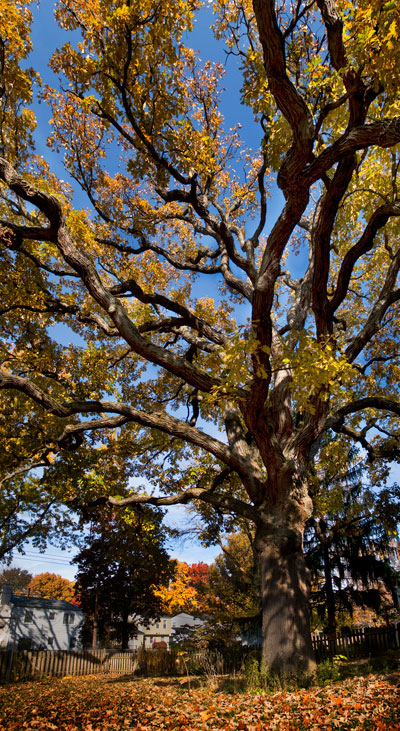
As a photographer, have you tried shooting multi-image panoramas? If you haven't you really should. It's just crazy fun. I made this seven image composite of our backyard oak tree in Adobe Photoshop CS4. I've also used Canon PhotoStitch to make panoramas. PhotoStich is a free program that came with your Canon camera software (other camera owners will have to help me out with this one- does Nikon offer a free photostitch software?) Even if you don't have a Canon camera, you can download it and use it all for free.

As you can see, even with multiple photographs, I wasn't able to get the whole tree in the frame. Maybe I can? What if I took multiple vertical rows of images stacked upon each other, and then tried to use the Adobe CS4 photomerge tool?

Also- If you do go and try to do this- make sure you shoot in manual and turn off autofocus. You'll want the images to have identical exposures and focal point- if they don't, your finished product could look very strange.

All of this panoramic photography has been prompted by two things. First, this incredible composite image from the latest National Geographic that must be seen in the magazine to be appreciated. And second, I have been tasked to shoot a vertical and horizontal panoramic photograph for my most recent assignment at Columbus State.

Although this type of photography might sound gimmicky, it allows us nature lovers to present the natural world in interesting way that captures so much more information than a single frame image. It's almost like being there, but not quite, but just close enough to be really interesting.

Tom

Also- Here's another free panoramic maker, that a reader pointed out to me, this one from Microsoft.

Wednesday, October 21, 2009

Welcome Back to Ohio


Ok- I'm not welcoming you back to Ohio, per se, but myself. Living a week in the cool, clean, and quiet air of the Maine woods was amazing, and it has taken some time to acclimate back to the city life. I'm giving it my all though.

Perhaps one of my greatest reminders of how wonderful Ohio is came this evening, as I scrolled through the wonderful images submitted to the Ohio Nature Photographers group on FLICKR. If you are a photographer and enjoy shooting the natural world of Ohio, I encourage you to join us. In under a year, we've gathered 227 members that have submitted over 3000 fantastic photographs of all things natural in Ohio.

And for everyone that has joined and contributed, I must thank you for creating such great photographs and reminding me that my home state is absolutely wonderful.

Tom

UPDATE- I myself have found the above slideshow mesmerizing. I dare you to watch it for only 10 seconds.

Friday, October 16, 2009

Good Night and Goodbye from Little Pond


Our stay has come to an end. Tomorrow we will head back to Columbus and leave Little Pond for Megan's Parents to enjoy. The next time we'll be back, ice will cover this pond and the geese that descended upon the water today will also be long gone. We've had a great vacation here in western Maine- we scaled two mountains, did the obligatory trip to L.L. Bean, and even ate a genuine New England boiled dinner held in the basement of the church where Megan and I were married. And Weston loved every bit of our stay. Can we ask for anything more?

When we visit here for a full week, we get a taste of what life in rural Maine is like- clean air and lots of nature, but the drive to town, to the store, to church, to the gas station- well, that just gets old. At home in the city, I never wish for more activity, more civilization, more things to do. But after a week in the Maine woods, I'm somewhat longing for our city once more. I know this feeling will be short lived- once back in the hub-bub of Columbus, I'll be wishing for the clean air and orange post-sunset glow reflecting into little pond.

Tom

Loon Fake Out


Megan, Weston, and I have had a wonderful time visiting Little Pond this week in Otisfield Maine. One bird that I'd always wanted to see swimming on the water here is a loon. I haven't yet seen one, but when we first arrived last Saturday, this cormorant got my heart beating quickly. It was far across the water, and without binoculars, its silhouette was mighty loon-like. A quick look through the resident Nikon bins and my excitement level dropped as soon as I saw the hooked bill of a cormorant.

Still- I hadn't seen cormorants in the past four years of exploring nature here, so it was interesting to watch them this week. A pair flies in very early in the morning and begins to fish, diving down and surfacing after 30 seconds or so. One afternoon, as we were about to leave for a hike, I looked down to the dock and saw this bird basking in the sun. A slow stalk with the camera ensued, and I was able to come within about 30 feet without it ever really caring that I was there.

Tom
Posted by Picasa