Showing posts with label wetlands. Show all posts

Thursday, June 18, 2009

Catawba Nights


Howdy all, are you ready for the weekend? Big day on Saturday for us at the Division of Natural Areas and Preserves, our annual Cranberry Bog open house, and we have 550 people signed up, with walkups sure to come as well. It makes for a long day, especially if it is hot and sunny.

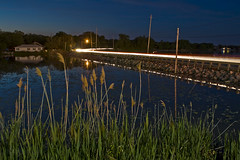
Some of you have seen my TA Photography blog where I put some of my favorite images that I've recently taken. I've set that blog up to be a photo gallery- the images are much larger there. I just added a thirty second time exposure from our Lake Erie trip two weeks ago. Here's a sample, but it looks so much better just a little bigger and viewed on a black background. See it here.

Tom

Sunday, June 07, 2009

Catawba Marshes, Lake Erie


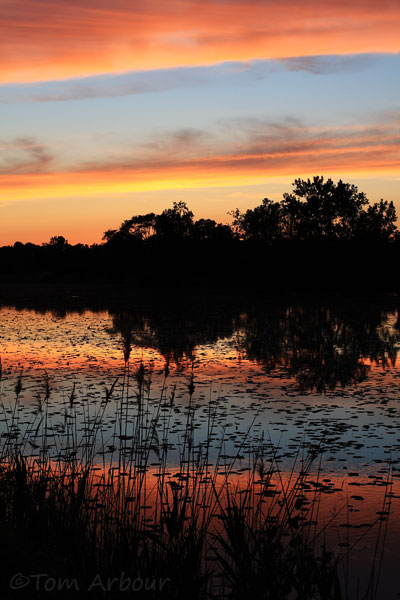
The floating leaved marshes between the mainland and Catawba Island provided for amazing reflective sunsets. I took this image from the parking lot of our hotel.

It's just too bad that the non-native invasive species, that giant grass in the foreground, Phragmites australis subsp. australis, or simply "Phragmites", has become so prevalent along the lakeshore. For more about this nasty plant, you need to watch this video.

There is a native subspecies of Phragmites, Phragmites australis subspecies americanus that isn't invasive, but it is quite rare. I've found it in Lake Erie Marshes and prairie fens further inland.

Tom

Thursday, May 28, 2009

Time for Collective Naturalizing 2009 Style

The field season is at me fast and furious. So much to see, so much to document. If you've been with me for a while, you'll remember last year's collective naturalizing posts. A list of pictures, some things I know, some I may not, but let's all work together to put names on these pictures that I took today from a swamp/fen/marsh complex in Ashtabula County with Jim Bissell and the Northeast Ohio Naturalists of the Cleveland Museum of Natural History. One hint: There are three species of plants pictured on the Ohio rare plant list. One endangered, one threatened, one potentially threatened.

Guesses welcome, OK, here we go:

1. Midland painted turtle, Chrysemys picta marginata
2. Swamp saxifrage, Saxifraga pensylvanica
3. Necklace sedge, Carex projecta, Ohio threatened species.
4. Viburnum opulus var. americanum (syn. Viburnum trilobum), Ohio endangered species. Yes, WoodsWalker, it is being munched by Viburnum leaf beetle!.
5. Some type of Sphinx moth. Any help here would be appreciated!
6. Beaver handiwork on Populus deltoides.
7. Carex stricta, tussock sedge.
8. Arisaema tryiphyllum subsp. stewardsonii
9. Sensitive fern, Onoclea sensibilis
10. Skunk cabbage, Symplocarpus foetidus
11. Highbush blueberry, Vaccinnium corymbosum
12. Two vascular plants here, one blooming, one not. Maianthemum canadense and Coptis trifolia
13. Cinnamon fern, Osmunda cinnamomea
14. Water or purple avens, Geum rivale, an Ohio potentially threatened species.
15. Me driving in the car during a deluge, which we just missed before we got back to the saftey of our vehicles. In case you didn't recognize, that's Ohio on the left, Pennsylvania on the right.

Thanks for chipping in everyone.

Tom

Thursday, February 05, 2009

Spread of the Giant Grass


Invasive Phragmites from Barbara Lucas on Vimeo.

Another great video produced by Barbara Lucas, this short film focuses on the non-native invasive Phragmites australis subsp. australis. Sometimes referred to as common or giant reed, many of us in "the biz" just call it Phragmites, pronounced frag-MY-tees. This plant is a wetland species, but will also grow on beaches and even wet, seeping hillsides- it doesn't need very much water. This is one plant that I've seen expand in my relatively short lifetime.

Also- There is a native phragmites that has been recently described and named Phragmites australis subsp. americanus. It too is mentioned in the video. Currently, this native grass is a state threatened species. I wrote and article detailing it in the 2007 Winter issue of Natural Ohio.

Tom