I can remember the first time I had ever heard that the indigo bunting even existed. I was probably in second grade. There was a substitute teacher at Riverview Elementary, Mrs. Johnson, who to my seven year old brain was crazy. I thought she was just totally loopy and I still to this day have never seen anyone whose face was as deeply crimson. You probably were a nice lady Mrs. Johnson, but I lived in fear that you weren't going to get me out of the classroom and out to the right bus. And for a second grader, not getting home to one's family is about the worst case scenario one can imagine.
I don't know how I still remember this, but one day in class she just started talking about the "prettiest litttle bluuuuu bird" called an indigo bunting, and she hadn't seen one in a long time. As a second grader, I had never seen one, and don't remember my first encounter, but I'll never forget Mrs. Johnson.
This morning while walking along the Olentangy River in Worthington, several indigo buntings were calling from the edge of the woods. This species likes edges and shrubby areas. If you'd like to see them, head to the Worthington Olentangy Parklands or check around old fields and scrubby habitats near you.
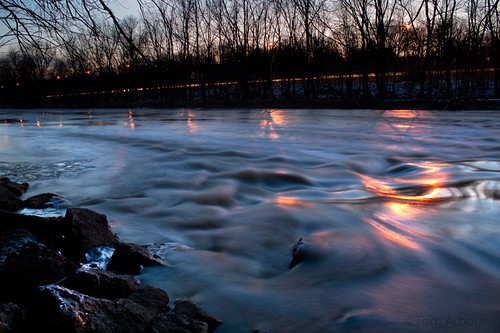
After quite a bit of work with the long lens, this evening I wanted to give my brain a different kind of photo workout, so I headed down to the Olentangy River. The sunset petered out, but the post sunset blues made for a wonderful reflection in the full, ice laden river. The streak in the background is northbound traffic on St. Rt. 315, one of Ohio's busiest commuter freeways.
Life is a collection of firsts, a string of events which we will never forget. Although it was short and sweet, this past Friday, Weston and his mom and dad went on their first nature hike along the Olentangy Bike trail. What a great day, and what a great job Weston did, sleeping most of the time strapped to his mom in a Weego baby carrier.
First, a stop at the playground. Now I have a reason to hang out at these places again. In a former life, I was a professional playground attendant in Shamu's Happy Harbor at Sea World Ohio.
A beautiful, early spring, blue sky day. I love how American sycamore bark contrasts with the blue sky. There are several majestic sycamores that line the Olentangy just north of I-270.
Three trees or one? Just off the asphalt path, this triple sycamore can't be missed. The trunks to come together about 5 feet off the ground, making it one tree.
The triple sycamore is situated near a bridge which crosses over this small tributary. As it heads towards the river, its path is quite natural and sinuous. The shale bedrock of the area is exposed- This is the same shale that is found all the way up in Cleveland. It is also the source of Central Ohio's high radon readings in homes and schools.
We took a small side trail near the creek, and I spotted a hermit thrush, a relative of the American robin.
Robins were also plenty active in the area, and were certainly less wary than the hermit thrush. There is something nice about seeing Robins in natural habitats instead of green lawns.
Going back towards the asphalt path, I noticed that small minnows were active in the stream, some of them tipping their noses and rubbing up against the stream bottom. How many fish do you see? If I had to guess, I would say these were probably black nosed dace, but that is just a guess. I used to catch these all the time as a kid in the creek behind our house, which eventually led to the Cuyahoga.
Yet another thing that reminded me of exploring creeks when I was younger was some of the bubbling brown algae that had started to bloom. This stuff is extremely slippery.
We left the creek, continuing to walk north, until we met up with a flock of white-throated sparrows.
At about this time, Weston was starting to stir a little bit, so we decided to turn back and head south to Worthington. On our walk back, I took note of what plants were starting to bolt, including:
Perhaps poison hemlock? You don't want to touch this one, ever. It will grow to 6 feet tall or more by the end of the summer.
Garlic mustard, a nasty non-native invasive species which you may remember from this post.
And, several clumps wild leeks, or ramps, which are famous in West Virginia.
Finally, I noticed a two species of plants in full flower. The flowering of these trees just happens to coincide with my spring hay-fever.
This is my contribution to this week's "My World" Meme. I invite you to participate and show your world as well. Go here to do so.
There's nothing like a 68 degree, late December day to motivate anybody to get out and start exploring. This past Saturday, Megan and I did just that, taking a hike along the Olentangy River near our new home in Worthington.
I say our "new" home, but it depends on what your definition of "new" is. We have lived here just shy of six months, and I still feel like I'm getting to know the ins and outs of our new house and have only scratched the surface when it comes to exploring our neighborhood. We have moved almost exactly two miles north from our last home, a rental in the Delawanda neighborhood of the Beechwold/Clintoville area. Before, I could be at the Olentangy river, literally, seconds. Our house was only two removed from the urban forest that covered the floodplain of the Olentangy. In our new neighborhood, there are homes close to the river as well, but our house is not one of them. We live about eight tenths of a mile east of the Olentangy, in the ever so 1960's-esque Worthington Estates.
Back to Saturday. Why not explore the same Olentangy river near our new home? It was only a matter of time before I brought the cameras to capture what we would see along the river. Feeling like spring, we parked the car, stepped into the park, past the playground, and onto the Olentangy Bikeway, one of the busiest bike paths in Ohio.
We walked north, and shortly we crossed under Wilson Bridge Road, continuing north where a footbridge leads the trail northwest across the river. I must say that the river here is a disappointment. Compared to the runs, riffles, pools further south, actually further into the City of Columbus, the river in Worthington has been channelized. Instead of the root wads of trees lining the bank, limestone rip rap is present, and the stream is one long corridor, even in times of lower water.
The river crosses under a major thoroughfare just north of this footbridge. If you've driven through Columbus, chances are you crossed the Olentangy River here on Interstate 270, the beltway that rings our city. One of our major commuter freeways in town, State Route 315, was built alongside the stream in this area and the river was probably channelized at the same time the new freeway was created. You may recognize this sign, especially if you are a buckeyes fan.
Looking north, towards the bridge that carries Interstate 270 across the Olentangy River.
The trick in these urban environments is to really look and explore- although rare and sensitive species may not be present in such disturbed areas, there are plenty of interesting things to be seen and discovered.
As we walked north of the bridge pictured above, the path takes on a more natural feeling. There are less invasive species in the floodplain forest, the trees are more mature. We walked further, and Megan stopped us suddenly.
A Virginia oppossum- I haven't seen one of these since we moved from Girard Road. This one was young- who knows why it had perished alongside the path. I would hate to think that it was hit by a bike, but I suppose that is always a possibility. Even in winter, the trail is used often.
Megan and I continued to walk, noting the occasional downy woodpecker, Canada goose, and mallard. And finally, we reached the end of the trail, which is adorned with one of our areas most interesting geologic features- concretions.
They may look small, but these boulders are huge. Megan gracefully and graciously volunteered herself to be the size reference for the concretions.
These are actually limestone concretions, founded bedded in the Ohio Shale, our bedrock of the area. The jury is out on exactly how they are formed, but sometimes there are fossilized fish bones in the center of them. The Ohio Geological Survey has put together a nice fact sheet that I'll have to more in depth. The ones here must have been dug up during building construction, I presume, and place in the grassy park area at the trail head for decoration.
There were still other interesting things to be seen on the floodplain that I noticed on the way back. First up was a nice (or not so nice) population of the invasive plant wintercreeper, or Euonymus fortunei. You may recognize this one from your home landscape, but in nature, it can escape and be a nasty weed. Here it has climbed up a sycamore tree.
A closeup of the leaves. Do they look familiar to you?
A little on down the trail, I saw another clump that was fruiting. I'm not sure if I have seen winter creeper fruiting before.
The wintercreeper wasn't the only thing fruiting. Columbus seems to be a hotbed for Osage Orange trees, a non-native species that was extensively planted for hedge rows and other agricultural purposes. I always find these fruits extremely interesting- for those of you that haven't seen them, they are about the size of a large grapefruit. I was reading on Wikipedia that some scientists have theorized that the fruits may have been eaten and dispersed by now extinct mammals. Amazing! The tree is native to the the south-central U.S.
This year seemed to be a mast year for box-elder trees. A maple, the samaras of these trees went crazy this year.
One last tree that seemed to be quite common along the drier reaches of the flood plain was honey locust, a tree that is adorned with three-pronged thorns often several inches long.
It was so great to get out with Megan this past Saturday and walk. She really gets the prize for growing this baby inside her. It is truly an amazing experience for us, and I get all the wonder, and she gets lots of pain! It is hard to believe that in only a few more months, we'll be doing walks with a three person family. Let the count down begin. I've added the widget Megan has on her blog to remind me of just how close this thing is all going to shake down!