Showing posts with label water. Show all posts

Wednesday, May 26, 2010

A Favorite Habitat

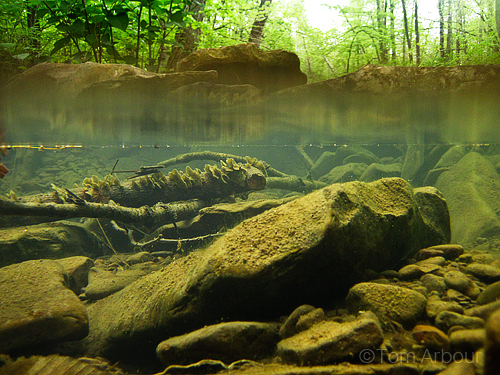
Headwater Stream, May 2, Scioto County, Ohio

Headwater streams- rivulets of water so small that they don't often appear on maps, are incredible habitats.  Their clear, cool water harbors a fascinating community of animals. Aquatic invertebrates, a diverse array of minnows, crayfish, water striders, larval salamanders, and tons of other biological organisms call these systems home.  A stream very much like the one pictured above is where I developed my love of natural history.  I was catching minnows with a toy butterfly net while my dad watched from around age six or so.  I gradually moved up to bigger minnows, and then added crayfish and salamanders to my quarry.  If you live near a headwater stream, explore it.  Find out what macroinvertebrates live amidst the rocks- and catch the fish and salamanders that depend upond the clear, cold, water.  They're one of my favorite habitats- and I think you'll enjoy exploring them too.

Tom

Tuesday, April 07, 2009

Nature Photography Interlude


This afternoon, I set out to photograph snowflakes. I put my reversing ring on my macro lens, and attached my 50mm 1.8 II lens for increased magnification. I even got out a piece of black posterboard. When I finally made it outside, the flakes had stopped falling.

I looked around and saw that one of our perennials, a prostrate herbaceous thing thing with white bell shaped flowers like a petunia (Kylee, help!), had water droplets beaded up on its hydrophobic leaves. What a great opportunity! I also used my Vivitar 285HV, off camera for this shot. The drop was only about a centimeter from the rear element of my reversed 50 mm lens. Tripod used as well. This shot reminds me a little bit of rain drop tipped moss spores I photographed last July.

RAW file processed in Canon Digital Photo Pro, sensor dust removed with CS4.

For those that are interested in shots like this, it can take quite a bit of gear. Here's all what I used.

Canon Digital Rebel XTI
Canon EF-S 60mm f/2.8 Macro USM
52mm to 52 mm reversing ring
Canon EF 50mm f/1.8 II reversed on the 60mm macro
Gitzo Explorer tripod (aluminum version)
Induro SA12 ball head.
Vivitar 285HV flash

Camera settings, Manual Mode, 1/200 of a second, f/22, Flash on manual, hand held off camera with sync cord, 1/16 power. Once a week I'm going to try to do one of these "how i got the shot" posts, they're fun, and it is time for me to start passing along some of my photo knowledge that I've been accumulating for the past year and a half, since I purchased my first DSLR camera.

One other thing- amid all this tech talk, be sure to compose your shots carefully, and try to put meaning into each and every capture. To me, the round drop of water reminds me a bit of our own little earth, just as it was birthed out of the center of a gigantic mother plant.

Tomorrow we'll finish up our Highbanks Hike. Lots more in the pipe as well, like macros of a live cicada larvae and the gelatinous gooey seeds of native mistletoe.

Tom
Tuesday, January 22, 2008

What holds back 6.3 billion gallons of water?


The O'Shaughnessy dam northwest of the City of Columbus. Megan and I checked out the this dam and 840 acre reservoir for the first time this past weekend after our frigid late afternoon visit to the Columbus Zoo.

The most interesting thing about the dam, to me, was the fascinating water patterns created by artificial waterfalls.


Although the above picture is rather artificial, further on down the spillway there were several "water steps" that looked as if they were meant to recreate the look of a natural waterfall. The pattern reminded me of a terrarium background that I had when I used to keep fire bellied toads ( Bombina orientalis) many years ago. The photograph on my background was probably taken on some tropical island. This day was anything but tropical, although not yet cold enough for ice to form around the fast moving water.


As far as natural history goes, I have been told that the limestone outcroppings are a sure place to see snow trilliums Trillium nivale, a species originally described and named by John Leonard Riddell M.D. from material he collected right here in Central Ohio. Ah, but those plants will have to wait a few more months!

This day, of natural interest, was a group of a dozen mallard or so ducks and the ubiquitous ring-billed gull. Although I tend to think of ring-bills as pests, I must say, it was quite fun photographing their soaring flight. I was able to practice my "panning" technique which I will hopefully perfect before our trip to Sanibel Island come March. And speaking of trips, I'll be headed to Wisconsin tomorrow to learn more about a data management system that may help us better track invasive species in Ohio. I hear that the high in Madison is going to be 9 tomorrow! Wish me luck....


Tom