Showing posts with label reptiles. Show all posts

Wednesday, May 04, 2011

Flora-quest Isn't Only Flowers

Ringneck Snake, Diadophis punctatus

Although Flora-Quest is a celebration of the late spring Flora of Shawnee State Park and Forest, Cheryl allows us to look at other things too.  Shawnee State Forest has quite possibly the state's most interesting reptile and amphibian populations, and during the weekend I was able to photograph these charasmatic herptiles.


Mole salamander larva, possibly a spotted salamander, Ambystoma maculata.

Northern Slimy Salamander, Plethodon glutinosus


-Tom

Friday, September 10, 2010

Friday, March 19, 2010

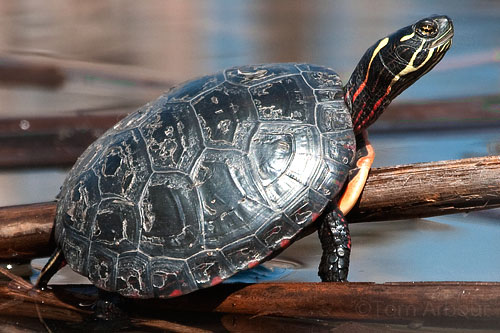
The Midland Painted Turtle

Chrysemys picta marginata, March 19th, Columbus Ohio

This is the creature of my childhood.  It is perhaps the species that sparked my obsession with nature and natural history.  I have my grandfather to thank for this affliction- he took me to the Seiberling Naturerealm, a Summit County Metropark in northeast Ohio, when I was pretty young, and I just didn't want to stop watching the painted turtles swim around the small pond.  Ever since, I have been absolutely fascinated by turtles.  At my office complex, we are fortunate to have a small wetland education area.  This wetland area is brimming with painted turtles, and today, I counted no less than eleven creatures sunning themselves on the dead cattail stems.

Tom

Thursday, September 24, 2009

Metro Parks Challenge #3 Battelle Darby

A curious goldfinch greets us along the trail

If you live in Ohio, or quite possibly if you really like aquatic ecosystems and live in another state, you may have heard of the "The Darby". This gem of an ecosystem lies just outside Columbus and drains the Darby Plains, once home to a great expanse of natural tall grass prairie, and now home to some of Ohio's richest agricultural land.

Even so, the Big and Little Darby Creeks are still amazingly rich in biodiversity- if I were at work I could tell you exactly how many rare species live in these streams, but safe to say it is dozens. The streams were designated by the Ohio Department of Natural Resources as State Scenic Rivers back in 1984 and recognized as national scenic rivers in 1994. I have to say that these two creeks are the biological gems of central Ohio, and I just simply need to visit these areas more often.

Battelle Darby Creek Metro Park is where to go to see the Big Darby, and even some of Little Darby, as the two streams reach their confluence in this Metro Park.
The streams are quite unassuming. But underneath their surfaces is a rich diversity of beautifully colored fish and freshwater mussels with bizarre life histories.

So what better place to introduce Weston to a world class ecosystem AND complete our third Metro Parks Hike for the year? Here he is in the backback- If you remember back to our Sharon Woods hike, we forgot the sun shade- but not this time.
However- We DID forget his bib! How fun it was to watch Mom get food all over the place. Murphy's law was certainly in place this day- forget the bib and he'll be sure to be extra messy with his baby barley cereal.

On our way along the trail, we encountered things like cutleaf coneflower, Rudbeckia laciniata.
And in higher drier meadows we saw one of the cudweed species in the genus Pseudognaphalium.

And we also got to introduce Weston to map turtles. This female was basking on a rock in a large pool created just downstream from the confluence of the Darby Creeks. She was absolutely huge, probably 10 inches long- dwarfing her male counterparts at the other end of the rock.

As we returned north through the most mature woods along the trail, I happened to spot the plant pictured above. Weird, I thought to myself, I've never seen this. I thought it might be an orchid. A quick e-mail to my colleague Rick Gardner after we returned home and he confirmed that my suspicion was indeed correct. He identified this as the autumn coralroot, Corallorhiza odontorhiza. Some plant species produce flowers that never open and are self fertilized- botanists call these cleistogamous flowers. Autumn coralroot can produce both types of flowers, so it is possible that these flowers will open eventually, or it is possible that they will remain closed and self fertilize.

Megan, Weston, and I had great fun at Battelle Darby Creek Metropark. We parked at the Cedar Ridge area and followed the Indian Ridge trail south to the Indian Ridge Picnic area and back. Here's an aerial view of the day's adventure.


View Metroparks Challenge in a larger map


Tom

Saturday, August 29, 2009

Shawnee- Baby Herps and an Orange Orchid- Camera Critters


Almost one week ago, I started this little adventure to Shawnee State Forest with the Ohio Heritage Naturalists, so I better finish it up- I'm sure most of you forgot where we left off- with the Liatris aspera, a beautiful blazing star.

We walked down and back a grassy forest trail that was full of the liatris, when I spotted a few of our naturalists on their knees, hunched over looking at something. Sure enough, it was a tiny, newly hatched five-lined skink, with a bright blue tail. We saw several of these tiny lizards throughout our adventure. Ray was kind enough to hold the skink for the camera.

I had noticed that not all of our naturalists joined us for this little side trip. Mind you, it was getting ridicuously hot by this point, and the humidity was up there as well. Jason and Weedpicker Cheryl said that it was actually cooler on the ground in this position. I'll let them explain it, but they were lined up like they were going somewhere on an imaginary roller coaster ride or something like that. I snapped the picture quickly, they were up and with us again in a flash.

Ahh, the beautiful view from picnic point. From this vantage, theOhio valley can be seen- Ohio on the left, and Kentucky on the right. You can just barely make out the river city of Portsmouth, Ohio, now a shadow of its once former self. It actually was home to a National Football League Franchise called the Portsmouth Spartans. The team left for Detroit in 1934- they're now known as the Detroit Lions.

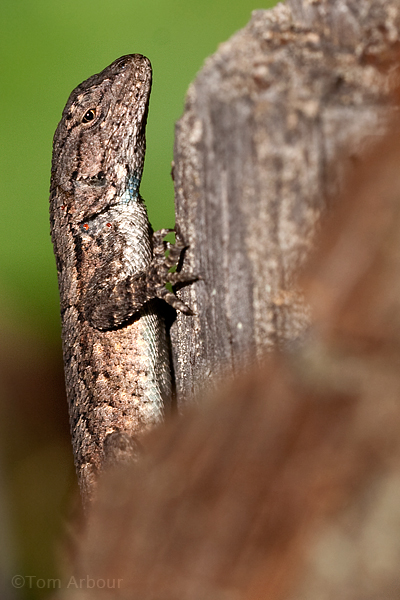
In addition to the grand vistas, there was plenty of interest at a much smaller level at picnic point. A tiny eastern fence lizard was basking on one of our van's Goodyear tires. The "r" in Goodyear gives quite a size reference- these newly hatched lizards were really, really little.

Jenny Richards, the naturalist at Shawnee State Park, found several other eastern fence lizards, and as I promised Kelly, here she is holding one of these little reptiles. I'm sure we could have found many more, but we needed to pack up our vans and head back to Columbus.

However- We couldn't miss the opportunity to stop and see this botanical wonder- the yellow fringed orchid, thanks again to Jenny. I've seen this species one other time, I believe, in the Oak Openings west of the Toledo. What an amazing plant. More orange than yellow, it was a great way to end our day of botanizing and naturalizing.

Tom

See what we found during the first part of our Shawnee Trip

This is my Camera Critters post for this week.

Wednesday, August 05, 2009

Komodo Dragon


Fortunately for us in Central Ohio, we don't have to travel far to see the largest lizard in the world. We have at least one living at the Columbus Zoo, and maybe more. This one is tiny compared to those I have seen at the Toronga Zoo in Sydney. Let's give this individual a few more years and see how big it gets.

Tom

Wednesday, April 08, 2009

Highbanks Wrapup

Although I've stretched this short hike out over almost a week, the trip did provide plenty of material that just screams spring. Highbanks Metro Park is great place, full of interesting habitats, and I hope to go there more frequently this summer.

After Megan and I stopped to check out the concretion in the shale, we walked slowly but steadily down to the floodplain of the Olentangy River. The woods at the base of the "high banks" are pretty srubby and weedy. Garlic mustard and Amur honeysuckle were definitely present, and the botanical diversity was fairly poor. But boy, the temperature was just right for a snake, I thought to myself.

Look carefully, this snake really blends in amongst the leaves and debris of the forest floor.

And after a quarter mile or so, I heard that distinctive rustling of the dry leaves sound, very subtle, but instantly recognizable. Either a lizard or a snake. I wouldn't expect to see any lizards in Delaware County although a five-lined skink wouldn't be out of the question, I would be surprised. It turned out to be a slithering garter snake. It is great to see native reptiles here at Highbanks. Down in Columbus, I never once have seen a snake.


We continued on and went under a bridge, and finally saw the mighty Olentangy. I'm kidding of course, this is not a gigantic river, definitely, but Highbanks has excellent riverine habitat. This portion of the stream has been designated as an official State Scenic River by the Ohio Department of Natural Resources.

As we continued back up into the woods, I picked up three more wildflower species not seen yet on our hike. The first was Erythronium, or trout lily, but it was not blooming.


Then, a little patch of harbinger-of-spring, a delicate little wildflower that I've never really seen in abundance,


And, a toadshade trillium just about to burst.

We kept walking, further upwoods, and we crossed a bridge. I've been proud of Megan- she's learning many of the names of common birds. I'm the person that is good with names in the family- she isn't. Still though, she'll see white breasted nuthatches, carolina chickadees, and call them out by name. At the aforementioned bridge, Megan saw this bird, and wondered what it was.


Two eastern Phoebes, a pair, with grass in their beaks. It looked like they had begun to build a nest somewhere on the bridge, probably underneath the structure. The first bird is pictured in an Ohio buckeye, one of our first native trees to leaf out here in Central Ohio.

We walked a little longer, picked up a hairy woodpecker, and I could tell Megan was getting a little tired with the little guy attached to her in the carrier, so I decided to give it a whirl. It is pretty fun.


And that my friends is a wrap-up of our April 2 hike, a beautiful spring day. The sun has returned, although it still looks to be cold for a few more days, slowing spring down a little bit. The countdown to the first killing frosts of Autumn surely has begun.

Tom

In the Summer of 2009, there was a large Gypsy Moth infestation at Highbanks Metropark. Take a look at pictures and video of the devastation.

Thursday, May 22, 2008

Sunday, May 04, 2008

The Power of Collective Naturalizing

Ok, I think I just made up a new phrase. What the heck do I mean by "the power of collective naturalizing"? One of the coolest things that I do as an ecologist is get together with other top notch ecologists and naturalists around the state, and we do what we love- we naturalize. Or botanize. Or bird. To most of us, we love it all. Just being in a natural area, interpreting the plants, the animals, the ecological systems, it is fantastic. And when you're with a bunch of people, it is amazing how many new things you can learn in just a few days in the field.

I was in the field three days this past week, in two parts of the state, and all three times with fantastic naturalists. Here are just some of the things we saw. Some of these things I know to species, other to genus, and others, I don't really have a clue. I want to know what you know. Know what something is? Comment, give the number, and tell us something about that plant or animal-maybe your experience with it, whether you see it often, or maybe it is rare in your area. Let's collective naturalize through the blog. This is an experiment and something new that I've never done here, but I think it could be quite fun.


1

2


3


4


5


6


7


8


9


10


11


12


13


14


15


16


17


18


19


20


21


22